4 minute read · Brand comparison
The main difference sits behind the inbox
Texting Blue and Blooio both describe ways for a team to work with iMessage, but their entry offers place responsibility in different places. Texting Blue says it connects an existing iPhone number to a shared web dashboard. Blooio’s pricing distinguishes provider-managed shared pools and dedicated numbers isolated to a workspace. That is a difference in the operating arrangement, not merely an aesthetic choice of dashboard.
Our source check on September 28, 2026 found details that should stay next to the headline prices: Texting Blue’s Lite tier is text-focused with a daily message allowance, while Blooio’s shared commercial tier has a new-conversation allowance. We have not installed either product. The tests below are intended to help a CRM owner verify what those descriptions mean for a particular setup.
| Decision | Texting Blue | Blooio |
|---|---|---|
| Sender arrangement | Connect an existing iPhone number | Managed shared or dedicated numbers by tier |
| Entry business price | Lite: $19 per number/month | Commercial Shared: $89/month |
| Published entry limit | 100 messages/day | 15 new conversations/day on Commercial Shared |
| Rich features | Lite specifies basic text messaging | Confirm the chosen tier’s media and workflow features |
| Integration question | Confirm which advertised connectors are live | Confirm the maintained connector and plan entitlement |
Keeping a number also means understanding its connection
Texting Blue says the existing iPhone continues to send and receive while the team accesses a browser dashboard. If retaining that number is the reason you are interested, ask for a demonstration of the exact device setup, permissions and supported operating-system version. The public description should be converted into an installation and recovery plan before relying on it for customer messages.
Also ask which conversations become visible to the team. A business owner may use one familiar phone number for both personal and customer exchanges. Do not connect it widely until the scope is understood. A clean separation may require a dedicated business device or number, but the decision should follow your actual access requirements and the product’s supported controls, not an assumption that a shared dashboard automatically filters private history.
Blooio makes the managed-number tier important
Blooio’s lower commercial offer uses managed shared infrastructure, while its dedicated tier changes the sender arrangement and price. If a persistent business identity is a requirement, compare the dedicated configuration with the other candidate’s proposed setup. If the project is a limited prototype, a shared tier may be sufficient. Write that tolerance down so it does not disappear when the prototype becomes customer-facing.
The provider also has a reply-only Inbound plan. That is a different option from initiating CRM follow-ups. Ask how your particular workflow maps to the plan: customer asks for information, rep follows up, reminder fires, or case reopens. A product family can support several modes without every mode being included in the lowest quoted tier.
A message allowance is not a new-conversation allowance
A fictional day with ten customers exchanging ten messages each has a very different shape from a day with one hundred first contacts. Texting Blue’s stated daily Lite message count and Blooio’s Commercial Shared new-conversation count cannot be compared as if they used the same denominator. Ask whether incoming messages, retries or ongoing replies consume each relevant allowance.
Prepare a small workload sheet with new contacts, returning contacts, outgoing messages, incoming messages and attachments in separate columns. Then get each vendor’s interpretation in writing. If a higher tier is required, update the price comparison before the trial. This is more useful than selecting a low subscription and discovering that the ordinary Monday workload belongs on another plan.
Verify the connector that will own the record
Texting Blue’s homepage lists integrations, but its FAQ and integration display do not consistently describe which are available now and which are coming later. Treat any disputed connector as unconfirmed until the supplier demonstrates it. For Blooio, confirm that the connector you need is maintained and supported under the proposed tier rather than merely possible through a custom API project.
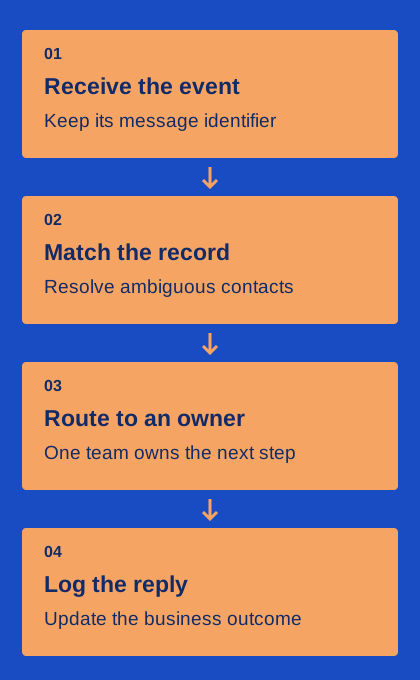
Test a reply, an assignment change and a request to stop further follow-up. Check the CRM record and every automation that could send the next message. Decide whether the CRM or messaging service owns the stop state and how the other system learns it. These are suggested integration checks for both candidates, not a claim that either currently mishandles those events.
Select the arrangement your team can maintain
Texting Blue is worth evaluating when sharing an existing iPhone number for straightforward team texting is the core requirement and its supported setup fits your business. Blooio is worth evaluating when you want to choose a provider-managed shared, dedicated or inbound arrangement. Ask what work each choice transfers to the supplier and what work remains with your CRM administrator.
Keep the final comparison grounded in the same daily workload, verified connector and sender requirements. Include the operational cost of the phone, the time needed to diagnose a missing reply and the effect of a tier upgrade. The right purchase leaves staff able to find a customer’s conversation and complete it, without guessing which device, plan or application currently owns the next step.